Reducing Assembly Complexity through DFMA: Hinge Assembly Case Study
Medical device manufacturers rely on partners who do more than build to print. The best ones can actively identify and correct assembly steps that waste operator time, introduce inconsistency, or slow down training on a new line.
Product Design for Manufacture and Assembly (DfMA) exists precisely to catch these issues before they become a recurring cost. At GMI Solutions, our manufacturing engineers treat the start of a customer's product transfer as the beginning of an ongoing improvement process. This case study shows how one hinge assembly turned into a meaningful efficiency win through DfMA engineering.
The Problem: Inefficiencies in Friction Hinge Assembly
A small friction hinge, used to hold a keyboard in place on a piece of medical equipment, required an assembly process far more cumbersome than its size suggested. Operators had to hold an individual nut steady by hand while flipping the hinge repeatedly, applying thread locker to a single screw, and threading that screw down into the held nut. This sequence was repeated four times per hinge, once for each screw-and-nut pairing, followed by a manual check to confirm each nut sat correctly in its hex-shaped cavity before final torque.
This is the kind of simple, recurring friction that design for manufacturing and assembly is meant to address: a process that works, but costs significantly more in operator time and training than it should.
The GMI Solution: Implementing DFMA Engineering
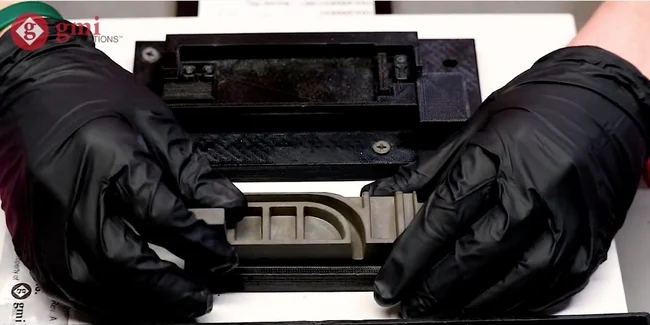
Operators working the hinge assembly line proposed a better way, bringing the solution to our manufacturing engineering team to develop it into something functional. Through DFMA engineering, our operators and engineers developed a fixture concept: a tool that could hold all four nuts in place simultaneously, letting an operator start every screw in a single pass with both hands free rather than four separate, clumsy cycles.
Our engineers designed a three-part fixture entirely in-house, prototyped it on 3D printers in our engineering lab, and tested it with the operators who had raised the original idea. A couple of tweaks and more iterative testing turned that early concept into a fixture ready for production use in a couple of days. Our DFMA services can solve floor-level problems like this one with purpose-built tools.
DFMA Results: Streamlined Assembly and Reduced Operator Training Time
The new fixture delivered measurable gains on the hinge line:
- Nearly 75% shorter process time for that single step, since operators start all four screws in one pass instead of four separate cycles and have both hands free.
- Reliable nut orientation, because the fixture holds all four nuts perfectly in place.
- Shorter training time for new hires picking up the process for the first time.
- Reduced operator frustration from dropped components and clumsy application of the threadlocker.
At a run rate of nearly 30,000 hinges per year, that time savings added up quickly across the full production volume, reducing the frustration operators had been managing under the old method.
Results like this are what design for manufacturing work is meant to deliver: a more consistent, higher-quality product paired with real efficiency gains that compound the longer we manufacture a customer's product. Imagine applying this philosophy over a program's life - you can see how the savings can become extremely significant over time. That’s what GMI does every day.
Partner With GMI for DFMA Services on Your Next Project
A hinge assembly is a small example, but it shows how product design for manufacture and assembly thinking can help at many levels, from changing the assembly process to reducing part count or creating jigs and fixtures. If your current assembly process has operators working around a bottleneck rather than through it, our manufacturing and engineering teams can take a closer look. Our ISO 13485-certified environment and Class 10,000 cleanroom are available for projects with critical quality requirements.
Contact GMI Solutions to talk through your next DFMA project.